
How We Made Leveraged Elon Tweet Markets Safe to Trade
Elon Musk tweet count markets are now live on Ultramarkets with up to 3x leverage. But the auto-close works differently from every other market we've listed — your positions may close early, and that's by design. Here's the engineering behind it.

In our last post, we explained why we say no to some markets — and hinted that some of them need a fundamentally different approach to listing. Elon Musk's tweet count markets are one of those markets. They're some of the most liquid, most traded, and most chaotic markets on Polymarket. They're also one of the most requested from our trader community.
Starting this week, you can trade these markets on Ultramarkets with up to 3x leverage.
But this post isn't really about the listing. It's about the engineering problem we had to solve to make leveraged trading on range markets safe, and why the solution works differently from every other market we've listed so far.
If you trade on Ultramarkets, read this. The auto-close on Elon tweet markets works differently, and you need to understand how before you open a position.
How auto-close normally works
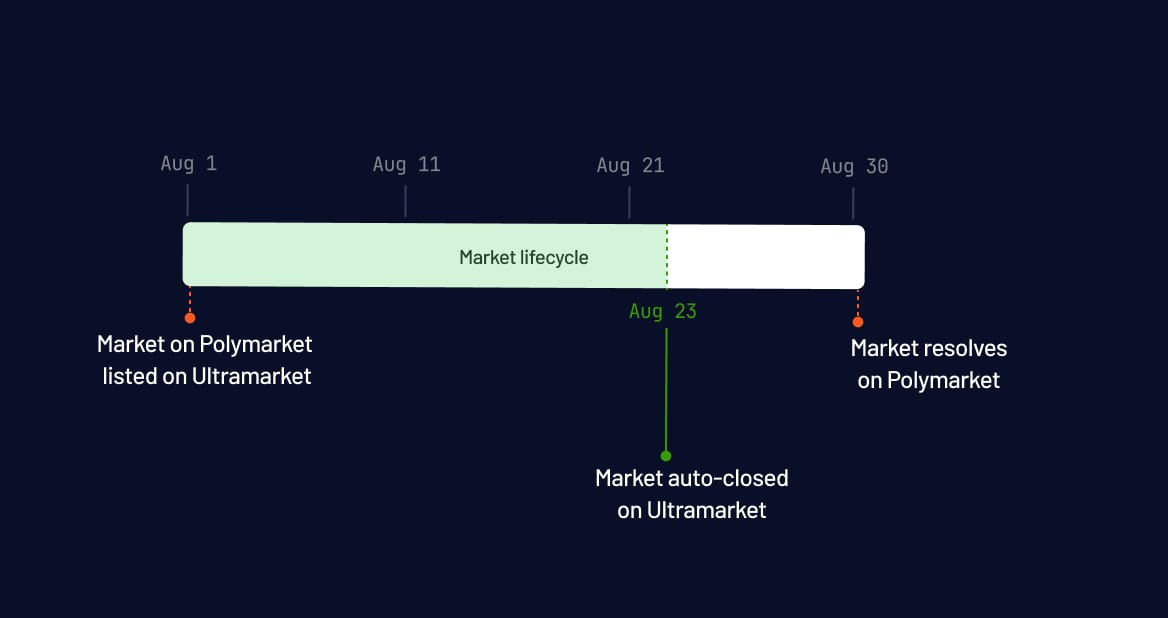
If you read our piece on how we evaluate markets before listing them, you know the core idea: every prediction market is hurtling toward a binary collision with reality, and leveraged positions can't survive that collision. Our solution is to exit before it arrives by auto-closing all positions while there's still active price discovery and order book depth.
For binary markets (yes/no, one outcome), a single auto-close timestamp is all you need. There's one dangerous moment called resolution, and you just need to be gone before it arrives.
Range markets break this assumption.
The problem with range markets
Elon Musk tweet count markets aren't binary. A 2-day market has 10 possible outcomes: buckets like <40, 40–64, 65–89, 90–114, all the way up to 215+. A weekly market has 30 buckets spanning even wider ranges. Only one bucket wins when the counting window closes. Every other bucket goes to zero.
The problem: individual buckets can effectively die during the counting window, not just at resolution.
Consider a 2-day market where Elon's count hits 92 by hour 30. The <40 bucket is dead. The 40–64 bucket is dead. And the 65–89 bucket just died because the count crossed 89. Meanwhile, the 215+ bucket is also effectively dead on the other end - Elon would need to tweet 123 more times in 18 hours, a rate far beyond anything observed historically.
These dangers come from two directions:
Upper bound risk. The tweet count is approaching or has exceeded a bucket's upper range. This can happen in two ways. Sometimes the count is climbing fast enough that even a conservative estimate of Elon's minimum remaining tweets would push past the bucket's ceiling - the outcome is becoming inevitable. Other times the count has already crossed the boundary outright. Either way, the price collapses toward zero.
Reachability risk. On the other end, the remaining time makes it effectively impossible for the count to reach a bucket's lower bound. Even under the most aggressive tweeting scenario, the count can't get there. The price collapses for the opposite reason - not because the count went too high, but because it can't go high enough.
Both create the same gap risk that resolution creates in binary markets. A leveraged long on "65–89" right before the count crosses 89 faces the same catastrophic price snap as a leveraged position held through resolution. And a leveraged long on "215+" when it becomes clear Elon can't reach 215 faces the same collapse.
A single auto-close timestamp can't protect you here, because the dangerous moment is different for every bucket and depends on what Elon actually does during the counting window.
Dynamic early-close: how it works
For Elon tweet markets, we replace the single auto-close timestamp with a system that has three layers of protection. Every position is closed at the earliest trigger.
Layer 1: Hard auto-close time. Every market still has a latest possible close date, set at listing. For 2-day markets, this fires 8 hours before the window closes. For weekly markets it's also 8 hours. This is the familiar auto-close you already know. It's the backstop.
Why these specific numbers? We analyzed every closed Elon tweet market on Polymarket going back to September 2025: 26 2-day markets and 34 weekly markets with reliable data. In both formats, the winning bucket becomes effectively certain (price stably above 90¢) a median of about 6.8 hours before the counting window ends. Our hard auto-close at 8 hours means we're out well before certainty in the vast majority of cases.
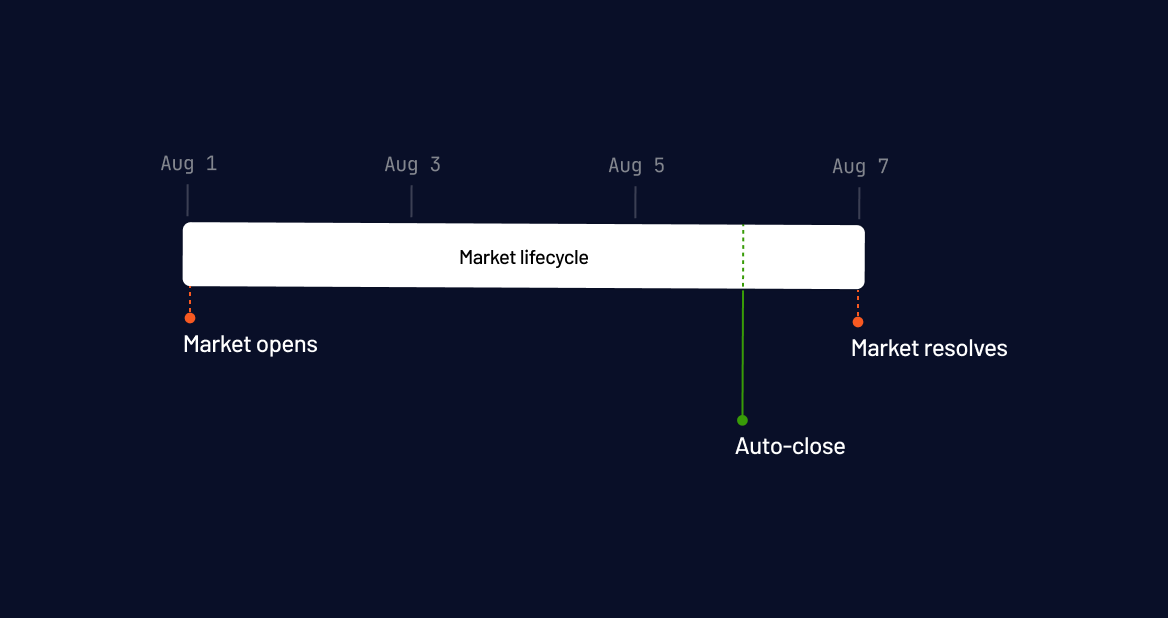
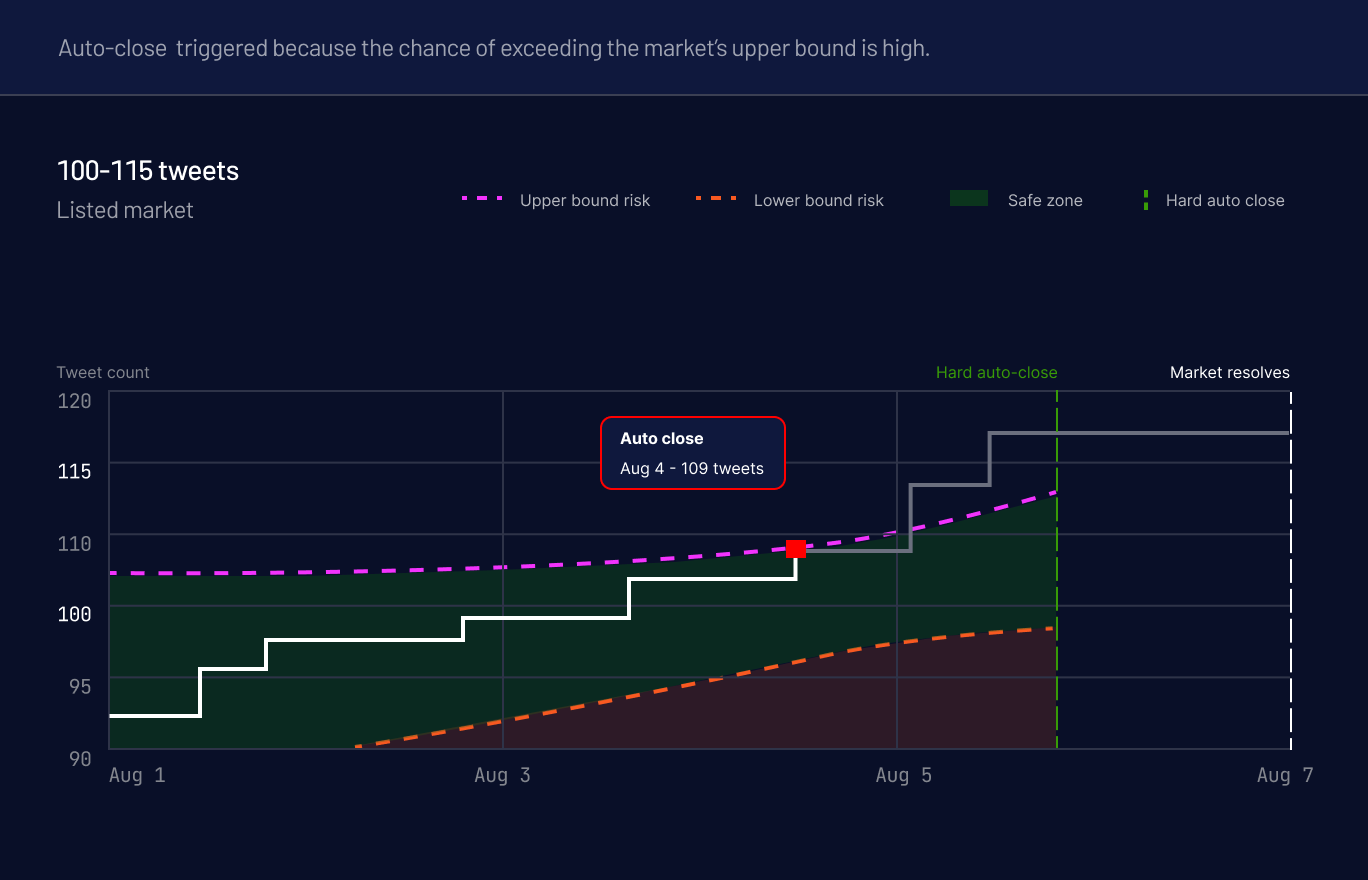
Layer 2: Upper bound close. This layer protects against the tweet count approaching or exceeding a bucket's upper boundary. It has two mechanisms that work together.
The primary protection is what we call inevitability detection. We continuously check whether even a conservative estimate of Elon's minimum remaining tweets would push the total count past a bucket's upper bound. If the answer is yes - if the bucket is essentially doomed regardless of what Elon does - we close all positions on that bucket. This fires early, often well before the count actually reaches the boundary, because the math already shows it's going to get there.
The secondary protection is a proximity trigger. If the live count gets close enough to a bucket's upper bound that a burst of tweets during our reaction window could cause a knockout, we close. This is the safety net in case inevitability detection didn't catch a fast-moving scenario.
Together, these two mechanisms mean we exit upper-bound situations early. The inevitability check gives us the widest safety margin; the proximity trigger catches anything that slips through.
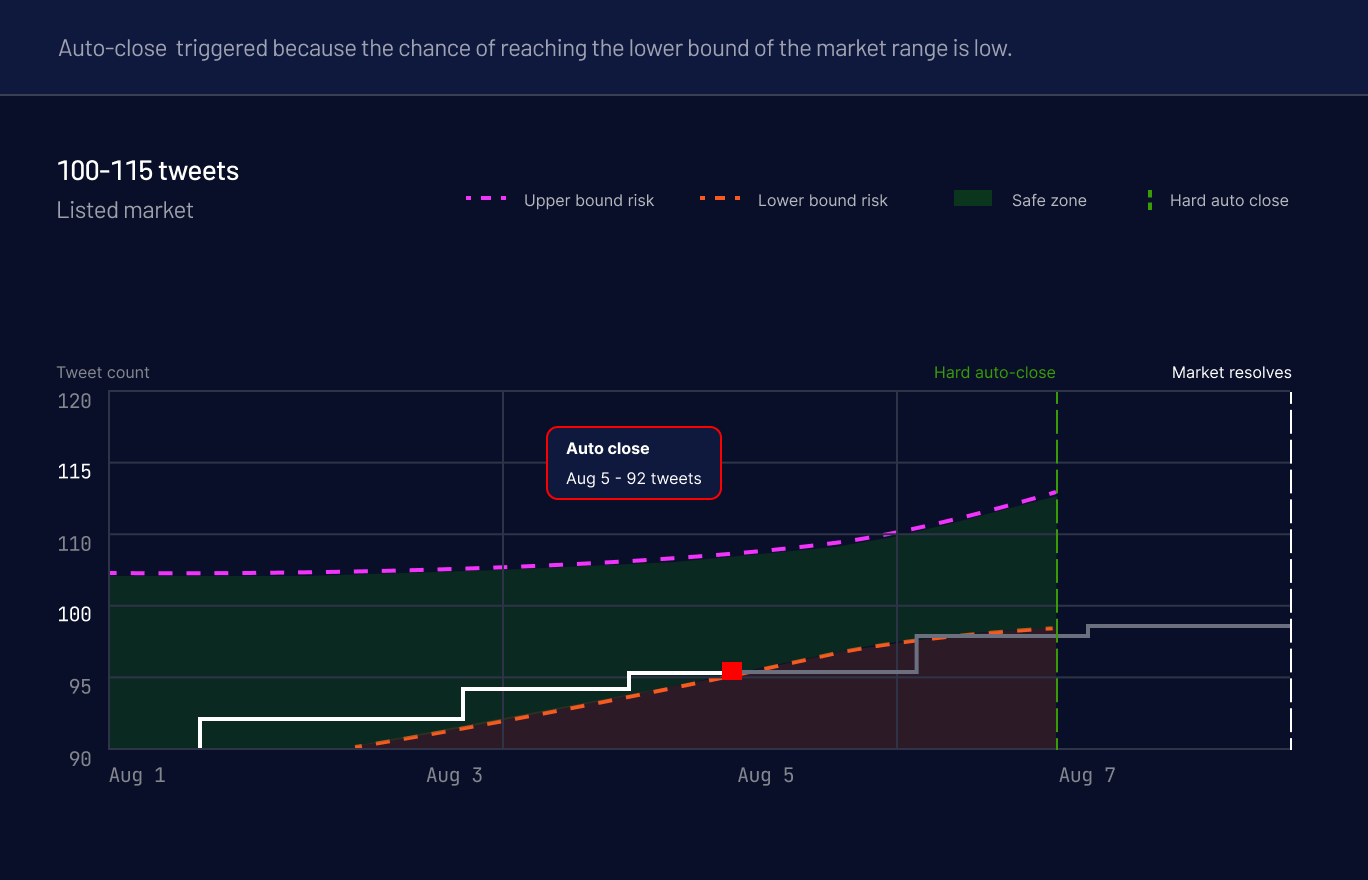
Layer 3: Reachability close. If the remaining time makes it effectively impossible for the count to reach a bucket's lower bound, we close all positions on that bucket. This uses a conservative ceiling on how much the count could increase: not an average rate, but a worst-case envelope.
When any trigger fires, all open positions on that bucket (longs and shorts) are force-closed at current market prices.
Why a single "tweets per hour" number doesn't work
This is the part that matters for anyone thinking about the risk engineering.
A naive approach would be: Elon tweets about 3 to 6 times per hour on average (based on 65–139 tweets over 48 hours), so in Y hours remaining, the maximum additional tweets is roughly 6 × Y plus some buffer. Simple.
This fails because tweeting is bursty, not smooth. Elon might post nothing for six hours, then fire off 20 tweets in 30 minutes during a news cycle or a reply chain. The data backs this up. In January 2026, some weekly markets saw winning buckets in the 460–579 tweet range, nearly double the typical 180–400. A single average rate will underestimate what can happen over the remaining window, and when you're running leveraged positions, underestimation is how vaults lose money.
Instead, we use what we call an envelope: a conservative ceiling built from worst-case historical behavior across multiple time horizons. We look at the maximum tweet bursts observed in 5-minute windows, 30-minute windows, 1-hour windows, 6-hour windows, and so on. The envelope at any given "time remaining" reflects the worst burst Elon has demonstrated at that time scale, plus a safety cushion on top.
We're not predicting Elon's behavior. We're bounding it.
The envelope is deliberately conservative. It's calibrated so that the real count should almost never exceed it. We're shipping with very conservative parameters for launch and will refine as we collect more data. Being wrong in the safe direction just means we close a bit earlier than necessary. Being wrong in the other direction means the vault takes losses. We know which side to err on.
What this means for you as a trader
Your positions may close earlier than the hard auto-close time. This is the key difference from every other market on Ultramarkets. On a standard binary market, the auto-close date is the auto-close date. On Elon tweet markets, your position could close hours or even days before the hard auto-close if an upper bound or reachability trigger fires for your specific bucket.
Different buckets close at different times. If you're trading the 65–89 bucket and someone else is trading 115–139, your positions might close at completely different times depending on where the count is. In our historical data, every single runner-up bucket collapsed from its pre-lock-in price to near zero once the winner became clear.
The rules are deterministic and known at listing time. We're not making discretionary calls about when to close. The parameters and safety buffers are all fixed when the market is listed. Nothing changes after you open a position except the live tweet count and the passage of time, both of which feed into pre-committed rules.
Max leverage starts at 3x. We're being conservative. Range markets with mid-window boundary risk are a new risk profile for us, and we'd rather scale leverage up after proving the system works than start high and discover edge cases the hard way.
You're still trading probability movement, not outcomes. The core thesis hasn't changed. You're profiting from the 12¢ to 18¢ move on a bucket, not from Elon actually tweeting a specific number of times. Dynamic early-close just means the window in which you capture that probability movement might be shorter than the full counting period.
The bigger picture
This is the first range market we're supporting on Ultramarkets. The infrastructure we built for it - dynamic close rules, real-time counter monitoring, burst-rate envelope calibration - generalizes to any range or count-based market. Once this system works for Elon tweets, it works for congressional vote counts, sports stat markets, and any other prediction market where individual outcomes can become determinable before final resolution.
Most leverage protocols avoid complex markets because the risk engineering is hard. You can't just slap a multiplier on an order book and call it done. The entire history of leveraged trading is littered with protocols that worked perfectly until the one scenario they didn't model.
Our approach has always been the same: understand exactly where the gap risk lives, and make sure we're gone before it arrives. For binary markets, that means being gone before resolution. For range markets, it means being gone before any bucket becomes determinable. The principle is identical. The implementation is harder.
We analyzed every historical Elon tweet market on Polymarket to calibrate our parameters. We know that 2-day markets typically lock in their winner about 2 hours before the window closes, that weekly markets behave similarly, and that extreme weeks can see outcomes locked in days early. We built our system around the worst cases, not the averages.
We're not doing anything clever with the leverage itself. We're just being extremely careful about when positions must close, and building systems that enforce it automatically.
This is what safe leverage on prediction markets looks like. Not higher multipliers. Not faster liquidations. Just knowing - precisely, mathematically, conservatively - when to get out.
Start trading Elon tweet markets at app.ultramarkets.xyz.

Comments ()